
WELCOME BONUS 300%
UP TO €2000 + 100
FREE SPINS
UP TO €2000 + 100
FREE SPINS
Home → Blackjack
Blackjack at EZZ Casino: Variants, Rules and Payouts
The Insurance Mistake: 7% Extra House Edge
Insurance in a six- to eight-deck blackjack game carries a house edge of 7.47% and an RTP of 92.53%, which makes it the most expensive bet listed among the blackjack variants. The side bet allows up to 50% of the main stake when the dealer shows an ace and pays 2:1 if the dealer then reveals a blackjack.
Basic strategy always declines insurance, because the 2:1 payout does not compensate for the probability of the dealer completing a blackjack. The only exception is a card counter at a true count of at least +3, where the remaining deck composition shifts the edge enough to justify the bet; with a single deck the edge falls to roughly 5.88% but remains negative for a non-counter.
A player who takes full insurance of 50 EUR on a 100 EUR main bet is therefore placing 50 EUR into a wager with an average expected loss of about 3.74 EUR, compared with only 0.46 EUR on the 100 EUR main game at a 0.46% edge. Over repeated dealer aces, the additional 7.47% edge compounds into a meaningful drain on the bankroll.
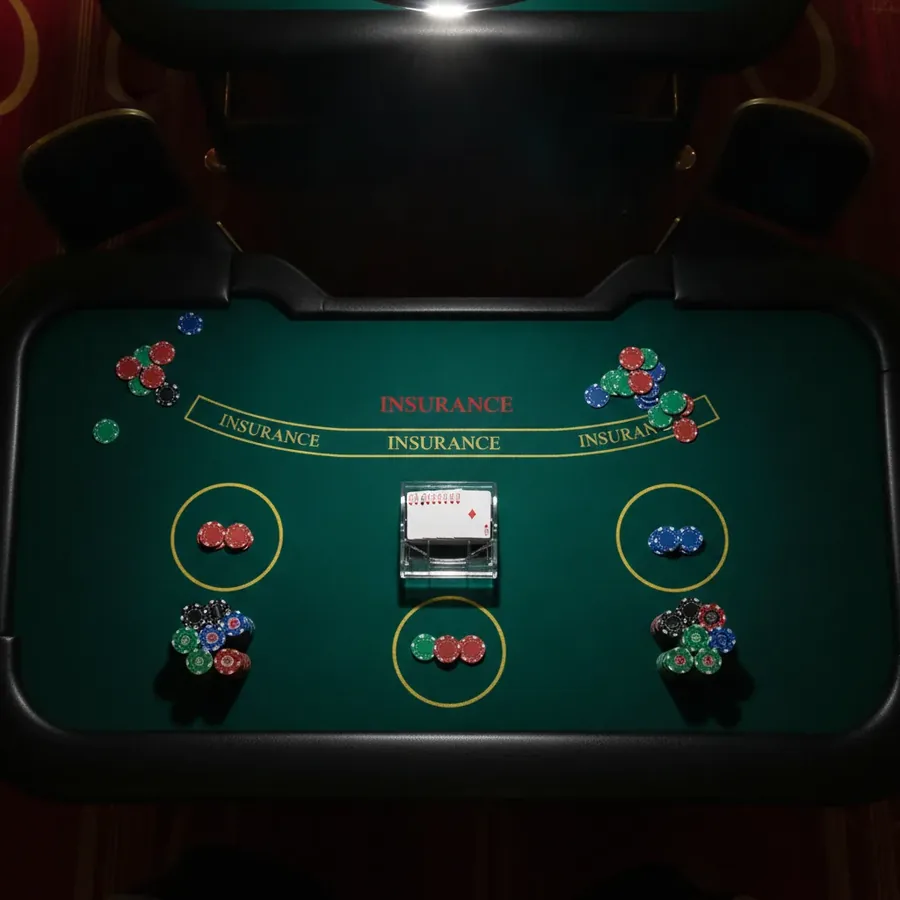
Continuous Shuffling Machines Reshuffle After Every Round
A continuous shuffling machine removes the cut-card break and feeds used cards back into the shoe after every round, which changes the card-counting conditions but leaves the published RTP figures unchanged when the rules are identical. The six-deck game with dealer standing on soft 17, doubling after a split and double on any first two cards still shows 99.54% RTP with a 0.46% house edge under basic strategy.
The rule effects remain the same in a continuous shuffle environment: a dealer hitting soft 17 lowers RTP by 0.22 percentage points, resplitting aces improves it by 0.08 percentage points and doubling after a split improves it by about 0.14 percentage points. The 6:5 payout change, by contrast, adds exactly +1.39 percentage points to the house edge regardless of the shuffling method.
For the reader, the practical consequence is that a continuous shuffling machine primarily removes the advantage of card counting, while the mathematical cost of each rule stays fixed. A 10 EUR blackjack under 6:5 pays 12 EUR instead of 15 EUR, and that payout cut costs more than any shuffling method ever could.
Early Surrender Is Gone From Many Tables
Late surrender is the only surrender form listed among the blackjack variants, with a rule effect of −0.08 percentage points on the house edge, meaning the player gives up the hand after the dealer has checked for blackjack and loses half the stake. Early surrender is worth much more, up to −0.6 percentage points, but it is extremely rare and not part of the standard table set.
The Liberal Vegas Strip ruleset includes late surrender alongside dealer standing on soft 17, doubling after a split and resplitting, producing an RTP of 99.72% and a house edge of 0.28%. A standard six-deck game with stand on soft 17, double on any first two cards and doubling after a split but no surrender sits at 99.54% RTP and a 0.46% house edge, so late surrender is worth about 0.08 percentage points on its own.
For a reader choosing between tables, the absence of early surrender removes a potential 0.6 percentage point improvement, while the presence of late surrender still returns 50% of the stake on a weak hand. A 100 EUR bet that is surrendered late loses 50 EUR instead of the full 100 EUR, which is the concrete saving behind the −0.08 percentage point effect.
Double Down or Just Hit on 11
Doubling down on 11 is a rule action in which the player doubles the stake and receives exactly one additional card, and the six-deck game with double on any first two cards permits it on every starting total. The RTP of 99.54% for a six-deck game with stand on soft 17, doubling after a split and no surrender assumes the player uses basic strategy and doubles when the count favours the action.
A simple hit on 11 takes one card without increasing the stake, while a double down raises the wager to twice the original amount for the same single card. The single-deck classic game with a 3:2 payout reaches 99.85% RTP and a 0.15% house edge, and the fewer decks lower the edge by about 0.48 percentage points compared with eight decks, but only when the player makes the correct double-down choices.
For the reader, doubling on 11 against a dealer’s weak upcard turns a favourable total into a higher expected-value play because the extra stake is placed at a moment when the player has the statistical advantage. Failing to double in that spot leaves money on the table, while hitting instead keeps the stake smaller but misses the added return the strategy expects.
Blackjack variants at a glance
| Variant | Payout | House edge | Rule | RTP |
|---|---|---|---|---|
| Blackjack Single deck, classic rules, 3:2 | Blackjack 3:2, win 1:1 | 0.15% | Fewer decks = lower edge; one deck gives about −0.48 percentage points compared with 8 decks. Often offset by a 6:5 payout. | 99.85% |
| Blackjack Surrender (late surrender) – rule effect | 50% of the stake returned | −0.08 percentage points | The player gives up the hand after the dealer has checked for blackjack and loses half the stake. Improves RTP by about 0.08 percentage points. Early surrender is worth much more (up to −0.6 percentage points) but is extremely rare. | n/a (rule modifier) |
| Blackjack 6:5 payout instead of 3:2 (6 decks) | Blackjack 6:5, win 1:1 | 1.85% | Replacing 3:2 with 6:5 adds exactly +1.39 percentage points to the casino's edge – more than any other rule change. On a €10 bet a blackjack pays €12 instead of €15. | 98.15% |
| Blackjack 6 decks, S17, DAS, DOA, 3:2 payout, basic strategy | Blackjack 3:2, regular win 1:1, insurance 2:1 | 0.46% | Dealer stands on soft 17; double down on any first two cards; doubling after a split allowed; no surrender. Basic strategy is required to reach this figure | 99.54% |
| Blackjack Liberal Vegas Strip (liberal rules, 3:2) | Blackjack 3:2, win 1:1 | 0.28% | The most player-friendly rule set: S17 + DAS + resplit + late surrender. Standard deviation 1.15 | 99.72% |
| Blackjack Insurance (6–8 decks) | Insurance 2:1 | 7.47% | Separate side bet of up to 50% of the main bet when the dealer shows an ace. Basic strategy ALWAYS declines it (except for card counters at a true count ≥ +3). With a single deck the edge is ≈ 5.88% | 92.53% |
Bet Two Percent of Your Bankroll per Hand
A flat stake of 2% of the bankroll per hand keeps the average loss per round predictable, because the house edge on Blackjack 6 decks, S17, DAS, DOA with 3:2 payout sits at 0.46%. That figure is the average share of each stake the casino keeps over the long run, and it only applies when basic strategy is followed. On a €1,000 bankroll the 2% rule means €20 per hand, so 100 hands cost about €9.20 on average at a 0.46% edge.
Blackjack Single deck, classic rules, 3:2 carries a house edge of just 0.15%, so the same 2% flat stake of €20 loses roughly €3 per 100 hands, less than a third of the six-deck figure. That difference of 0.31 percentage points is what fewer decks buy at the table. A player who moves from six decks to one deck at the same stake cuts the expected cost per 100 rounds from €9.20 to €3.00.
Choosing a table where blackjack pays 6:5 instead of 3:2 pushes the house edge to 1.85%, so a €20 stake costs about €37 per 100 hands, roughly four times the 3:2 figure. On a €10 bet a blackjack pays €12 instead of €15, a shortfall of €3 per blackjack. The 2% rule therefore only holds its cost profile on tables that still pay 3:2.
Stand-on-17 Rule and Its Meaning for Players
The dealer standing on soft 17 is worth 0.22 percentage points against the player when the dealer instead hits soft 17, so Blackjack 6 decks, S17, DAS, DOA reaches an RTP of 99.54%. RTP is the theoretical long-run return over hundreds of thousands of hands, not a forecast for one session. On €1,000 of total stakes the S17 rule saves about €2.20 compared with the same table played H17.
Blackjack Liberal Vegas Strip, which combines S17 with doubling after a split, resplitting and late surrender, shows an RTP of 99.72% and a house edge of 0.28%. Its standard deviation is 1.15. That is 0.18 percentage points better than the plain S17, DAS, DOA table, which translates to €1.80 less expected cost per €1,000 staked.
A 6:5 payout on a six-deck game, by contrast, lifts the house edge to 1.85% and drops RTP to 98.15%, a swing of exactly +1.39 percentage points. That single change costs more than any rule variation around soft 17. At a €10 stake a blackjack returns €12 instead of €15, and 100 such rounds widen the gap by €300 in payouts.
Doubling After a Split: Which Tables Allow It
Doubling after a split lowers the house edge by about 0.14 percentage points, and the Blackjack 6 decks, S17, DAS, DOA table includes it at an RTP of 99.54%. Doubling means the stake is multiplied by two in exchange for exactly one more card. On a €20 base stake the doubled hand puts €40 at risk, and the 0.14 percentage point gain is worth about €1.40 per €1,000 wagered.
Resplitting aces adds a further 0.08 percentage points, so a table that permits both DAS and RSA improves the return by 0.22 percentage points in total. Blackjack Liberal Vegas Strip, with S17, DAS, resplit and late surrender, sits at a house edge of 0.28%. That is 0.18 percentage points below the 0.46% of the six-deck S17, DAS, DOA game.
Going from eight decks to six decks is worth only about 0.02 percentage points, a much smaller gain than DAS. Blackjack Single deck, classic rules, 3:2 shows how far the deck count can push the edge: 0.15% house edge and 99.85% RTP. A player comparing tables should weigh DAS and RSA before counting decks, since those two rules together outweigh the deck reduction by about ten times.
Splitting at a Live Table, Step by Step
A split starts when the first two cards form a pair, and the table then allows up to four hands from that pair. At Lightning Blackjack from Evolution the bet range runs from 1 to 2,500 EUR, and the game reports an RTP of 99.56%. Splitting does not change the stake per hand, so a pair split into two hands doubles the total amount committed to the round.
Step two is checking whether the table pays doubling after a split, because that rule is worth 0.14 percentage points. Step three is checking aces: resplitting aces improves the return by 0.08 percentage points, while split aces usually receive one card each. At Blackjack Party from Evolution the bet range is 1.00 to 1,000 EUR, and the round is run by two hosts.
Step four is confirming the blackjack payout before splitting, because a 6:5 game returns €12 on a €10 bet while a 3:2 game returns €15. The difference of €3 per blackjack is larger than any split-rule gain. Quantum Blackjack Plus Live from Playtech accepts 1 to 5,000 EUR per bet and pays quantum multipliers up to 1,000x on three-card combinations totalling 21 points, with an RTP of 99.57% under optimal strategy.
The 3:2 Blackjack Payout Explained
A 3:2 blackjack payout returns €150 on a €100 stake, while a 6:5 payout returns only €120 on the same €100. That €30 gap per blackjack is the reason Blackjack 6 decks, S17, DAS, DOA lists an RTP of 99.54% while the 6:5 version of a six-deck game drops to 98.15%. The switch adds exactly +1.39 percentage points to the casino's edge.
Regular wins still pay 1:1 in both versions, so only the natural blackjack changes value. Insurance pays 2:1 but lowers the return in the long run: Blackjack Insurance on six to eight decks carries an RTP of 92.53% and a house edge of 7.47%, and basic strategy always declines it. With a single deck the insurance edge is about 5.88%.
A player who sees 100 blackjacks at a €10 stake collects €1,500 at 3:2 but only €1,200 at 6:5, a shortfall of €300. Blackjack Single deck, classic rules, 3:2 reaches 99.85% RTP and 0.15% house edge, but that advantage is often offset when the same table pays 6:5. Confirming the payout before sitting down is therefore the single most valuable check at the table.
Even Money only possible with Dealer Ace
Even money in blackjack only becomes possible when the dealer shows an ace and the player holds a natural 21. The question is always whether to accept a guaranteed 1:1 return on the main stake or to risk the 3:2 payout of 150 EUR on a 100 EUR stake. This choice appears because the dealer may also have blackjack, which would cancel the player's win entirely.
The insurance side bet behind even money pays 2:1 and carries a house edge of 7.47% with six to eight decks. Basic strategy always declines insurance except for card counters at a true count of +3 or higher. Taking even money is mathematically identical to taking insurance on a blackjack, which means the player locks in a smaller but certain payout.
With Blackjack Liberal Vegas Strip at RTP 99.72% and a house edge of 0.28%, a player who regularly accepts even money gives back part of that advantage. On a 100 EUR blackjack, the choice is between a guaranteed 100 EUR profit and a 150 EUR payout that fails only when the dealer also has blackjack. The rule set includes late surrender, which can protect other hands.
Soft vs Hard Hands in Practice
A soft hand contains an ace counted as 11 without busting, while a hard hand either has no ace or counts the ace as 1. The practical distinction changes basic strategy dramatically, because a soft 17 can be hit without risk of busting. Blackjack Liberal Vegas Strip with S17 means the dealer stands on soft 17, which keeps the house edge at 0.28%.
The rule effect of dealer hitting soft 17 adds exactly 0.22 percentage points to the house edge. In a six-deck shoe with S17, DAS, DOA and 3:2 payouts, the RTP is 99.54% and the house edge is 0.46%. That is the long-run cost of playing a hard or soft hand without adjusting strategy to the dealer's standing rule.
Doubling down on a soft hand is a core strategic option, and the rule DOA allows a double on any first two cards. With Blackjack Liberal Vegas Strip, the player may double after a split, which improves RTP by about 0.14 percentage points. Resplitting aces improves it by 0.08 percentage points, while the standard deviation of 1.15 shows moderate variance per round.
A Side Bet Every Round: The Budget Lasts 30 Rounds
A side bet placed every round changes the practical lifespan of a bankroll, because the insurance side bet with a house edge of 7.47% costs far more per round than the main blackjack bet. On a 10 EUR main bet, insurance of 5 EUR returns only 92.53% as RTP in the long run, meaning the average loss on that side bet is 0.37 EUR per round.
With a budget of 300 EUR and a flat 10 EUR main bet, the main game alone would last 30 rounds if no wins or losses changed the balance. Adding a 5 EUR insurance side bet every round raises the total stake to 15 EUR per round, so the same 300 EUR budget lasts only 20 rounds. That calculation assumes no blackjack payout alters the balance.
The 6:5 payout alternative shows how side bets are not the only drain on a bankroll. Replacing 3:2 with 6:5 adds exactly 1.39 percentage points to the house edge, producing an RTP of 98.15%. On a 10 EUR bet, a blackjack pays 12 EUR instead of 15 EUR, which is a larger long-run penalty than most side bets except insurance.
Six to Eight Decks in the Shoe
The number of decks in the shoe directly changes the house edge, with six decks as the baseline for the Blackjack 6 decks, S17, DAS, DOA game at RTP 99.54% and house edge 0.46%. Moving from six decks to eight decks increases the house edge by about 0.02 percentage points. The difference is small but measurable over hundreds of thousands of rounds.
A single deck with classic rules and a 3:2 payout reaches RTP 99.85% and a house edge of 0.15%, which is about 0.48 percentage points lower than an eight-deck shoe. Blackjack Liberal Vegas Strip uses a shoe format with S17, DAS, resplit and late surrender, keeping the house edge at 0.28% despite multiple decks.
The practical effect of deck count appears in the insurance side bet, where a single deck lowers the edge to about 5.88% against 7.47% for six to eight decks. The rule modifiers H17, RSA and DAS each shift the house edge by 0.22, 0.08 and 0.14 percentage points respectively, which outweighs the small deck-count difference.
The Shoe, the Cut Card and 75% Penetration
The cut card in a shoe game determines how many cards are dealt before the dealer shuffles, and 75 percent penetration means roughly three quarters of the shoe is played. The Blackjack 6 decks, S17, DAS, DOA game with basic strategy reaches RTP 99.54% only when the player follows the optimal decisions for the exact rules in play.
Penetration affects card counters far more than basic strategy players, because a deeper cut card reveals more information about the remaining deck composition. The standard deviation of 1.15 in Blackjack Liberal Vegas Strip shows that individual rounds swing around the 0.28% house edge, and penetration does not change that long-run average.
In live tables such as Lightning Blackjack by Evolution, the bet range spans 1 to 2,500 EUR and the RTP is 99.56%, while Quantum Blackjack Plus Live by Playtech offers a range of 1 to 5,000 EUR with an RTP of 99.57% under optimal strategy. The shoe, cut card and penetration rules for those live games follow the operator's table settings.
Contact
Live - online chat
Banking









Providers












EZZ Casino 2026